
Canada's Tiny Perfect Boomer: Margaret Atwood

Rarely have I felt such a strong combination of delight and disappointment as rendered by Margaret Atwood’s new Book of Lives: A Memoir of Sorts (McClelland & Stewart, of course, 2025). It gives fans so much—and yet withholds so much as well.
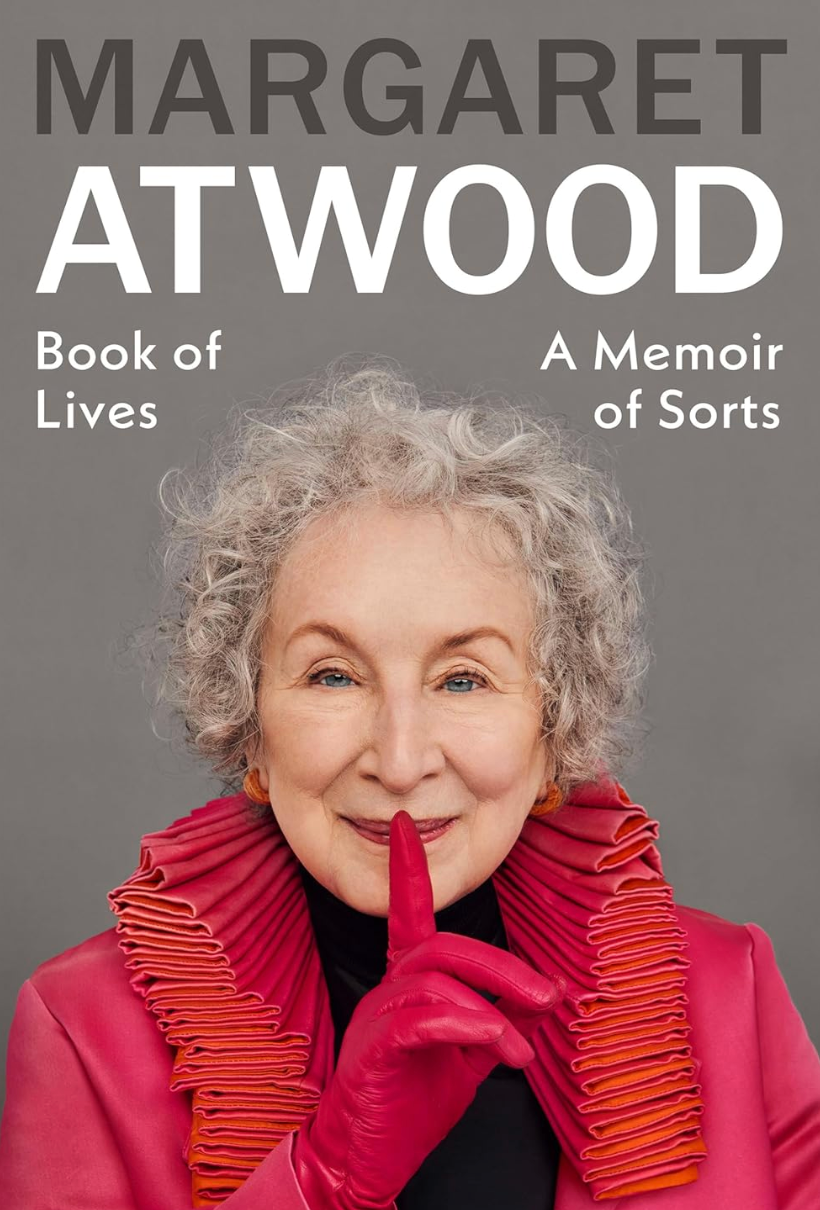
Lady Margaret (in Britain she would surely have been elevated to the peerage: she is a Companion of the Order of Canada, that order’s highest degree) gives us a thoroughly charming overview of her life and letters. Her cats’ eyes roam with feline amusement and, often, bemusement, over a life starred with celebrities-as-chums (from fellow Booker Prize-winners to at least one governor-general) that started literally in the backwoods of Quebec and Ontario. Her biologist father took the family to the hinterland each summer for years, and Margaret never forgot who’s who, grounded as she was in simple living, hard work, and nature’s many lessons.
See her characteristic smile on the book jacket! She is adorned like a grande dame yet those curls—those curls!—hint at just how unseriously she takes herself. She gazes out at the reader with a conspiratorial finger to her lips. “Come on over here and I’ll tell you a story—or a secret.”
Alas, this is not a tell-all—not hardly. Atwood doesn’t avoid tough subjects, from familial disappointments to authorial rivalries. But the spoonful of sugar is always at hand. She is unfailingly decent even to her adversaries—and she has acquired a few, usually folks afflicted with envy that is as stupid as it is inevitable. And she only lightly touches on only some of her many successes and resulting awards.
(This is not sentimentality. After finally winning the Booker Prize for which she had previously been nominated several times, she notes that “Canadians are prone to be offended by the success of other Canadians”—our version of the “tall poppy syndrome.” Bizarrely, Jan Wong, of all people, decided to savage her in the pages of The Globe and Mail, and this is the only instance in the book in which Atwood lashes back. Good on her for doing so: Wong was both wildly wrong and inexplicably venomous. Atwood yet manages to remain both personable and reasonable in her retort.)
Like many Canadians of that generation, Atwood sought success in the United States. On a fellowship at Harvard for a Ph.D., she nonetheless ended up back in Toronto to teach and write, and never completed her dissertation. (She ought to have been granted one for writing Survival: A Thematic Guide to Canadian Literature [Anansi, 1972], perhaps the best book ever written on its subject.)
I confess to wishing that someone had inspired her to keep writing about contemporary Canada. The range of her novels is astounding: from historical Alias Grace to the science fiction of the MaddAddam trilogy. But had she concentrated her gaze and reflection upon the small world so precisely depicted in The Robber Bride, she could have given us an Atwood’s Toronto equal to Joyce's Dublin and Dickens’s London—or perhaps Carl Hiaasen's Florida. As we all know, however, she left dysfunctional Toronto for dystopian America and, yes, The Handmaid’s Tale.
As a picture-perfect Baby Boomer, she long wanted to get married and have kids. But she also respected her partner’s wounds and preferences—so she never did press Graeme Gibson to tie the knot, for which he apologized only just in the nick of time as he died of cancer. Why, oh, why, did this brave, strong woman not insist but instead enable (this seems le mot juste) her man for decades?
She is yet clearly a feminist, but not on purpose and not at the barricades. Instead, she advanced the cause of women’s rights just by being Margaret Atwood: one tough mother in the forest, one gimlet-eyed critic in the press, and one beautiful novelist on the page who just wrote so elegantly, sprightly, and intelligently that the argument for the equality of women needed no explication. (And all that was before the global phenomenon of The Handmaid’s Tale.)
The memoir also hints at Christianity in the background, and in the atmosphere, of a Canadian growing up in the middle of the last century whose student years coincided with the liberation of the Boomers from all that was their parents’—including Christianity. Her own parents weren’t churchgoers, but most Canadians were back then. Young Margaret acquired some church experience through friends. And she learned her way appreciatively around a Bible, although without indicating any sense of it being anything other than a classic.
Witchcraft—clearly of the “white” variety—shows up at least as often. Young Margaret also learned to read tarot cards, and she hints that this party trick for her could mean something more. The reader of this volume will search in vain, however, for any form of spirituality exercising a guiding, let alone compelling, role in her life—in good emancipated Boomer fashion.
The disappointment comes, then, in reading over 500 pages and feeling at the end that that was a long and lovely cocktail party spent listening to a fascinating acquaintance. Splendidly entertaining—but, well, what of it?

One thinks of another recent autobiography by another highly successful Canadian, a younger contemporary of Atwood’s whose editorial career especially at Vanity Fair defined a parallel sort of literary success: Graydon Carter. In his When the Going Was Good: An Editor’s Adventures During the Last Golden Age of Magazines (Penguin, 2025), Carter also exudes charm in every graf. But at the end, we don’t learn what most of us also wanted to learn from Margaret Atwood: Who are you, and how did you do what you did?
We read such books to learn about greatness, what it is and how it works. How did Graydon Carter develop the crucial ability to discern what to put in his magazine, and where, and at what length, in the company of what other elements? He had to perform that magic of curation over and over again to make Vanity Fair the cultural touchstone it was for over a decade.
How did he learn how to combine so successfully high-quality writing with fashion and luxury goods and travel features—something Esquire also did well, and a dozen others (from GQ to Playboy to Chatelaine) did much less well? We learn almost nothing from his process, almost no “life lessons.” Instead, we are regaled with a stream of clever anecdotes told in an oddly passive “And then this happened to me…” style that is humble (crucial in such a genre) but also unilluminating.
So with Margaret Atwood. She does discuss a number of her books briefly as milestones, but what animated that writing? And how did she sustain her career and live her apparently mostly happy life: 50 years of writing 50+ books and innumerable poems, giving interviews (in itself a whole book: Conversations [Ontario Review Press, 1990—yes, just up to 1990!]) and speeches, and more?
To be fair, she has already blessed us with a book on her craft, and a good one: Negotiating with the Dead: A Writer on Writing (Cambridge University Press, 2002). But on life? On her?
All through this memoir, Atwood sustains a thread of doubleness. It isn’t duplicity. She isn’t misleading us. But she hints again and again at alter egos, Döppelganger, shadow selves, and the like. What is she not telling us? Who else is behind that enigmatic smile?
Someone so interested in Big Topics—familial, historical, political, social, moral, and aesthetic—is strangely reticent about the Big Questions . . . and Answers. What is the meaning of life—or, at least, of hers? (Don’t leave it to the earnest, jejune thesis writers. Tell us!)
Instead, Atwood’s world has the low metaphysical ceiling and the flat secularity, albeit tinged with a little New Age spirituality, typical of the determinedly post-Christian Canadian boomers. What I would give to read Margaret Atwood taking a single, long look at Jesus Christ!
In Book of Lives, Margaret Atwood talks about herself and her amazing career for half a thousand pages and somehow avoids coming crushingly across like an imposing genius or a benign alien. Instead, she seems like someone you’d enjoy having as a neighbour—and even more as a friend. That in itself is a tour de force.
But, Lady Margaret, could we yet beg you for more, and have you open your capacious and complicated soul to us?
Another book, if you please.


